"How I Learned to Stop Worrying and Love the (Critical) Bomb"
By Chrissy Daniels
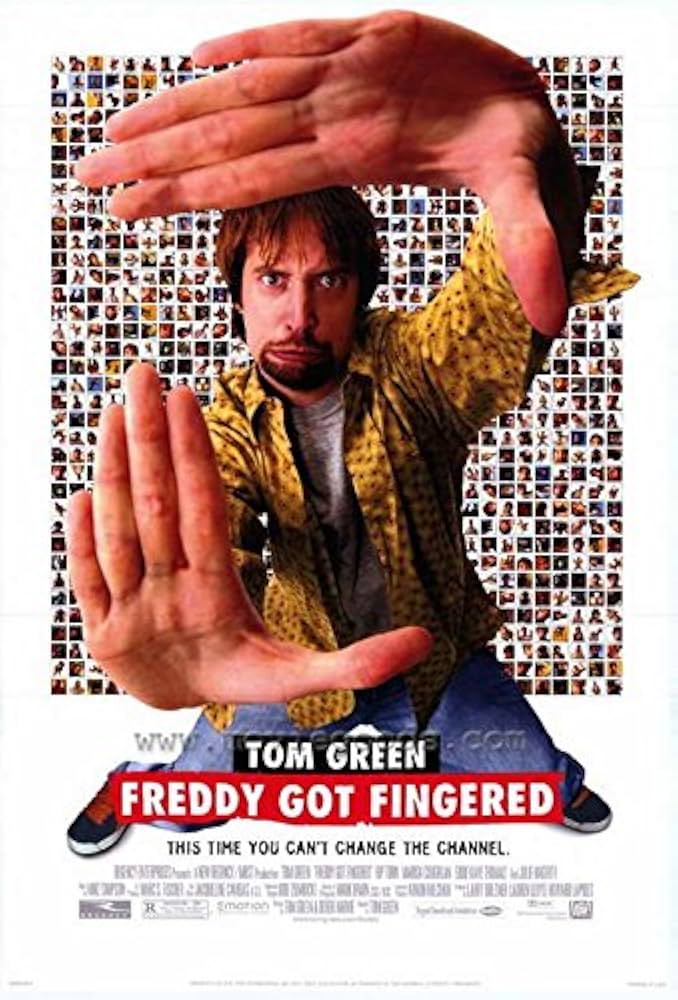
At the onset of my interest in film, half a decade prior to me developing a taste for the weird and avant‑garde, one of the most seminal texts for me was the Wikipedia page, “List of films considered the worst”. Cataloguing a cinematic history stretching back to the 1930’s (although since, the page has been split in two, separating the 20th and 21st centuries), this article was my first exposure to many classically bad films like “Manos: The Hands of Fate” and “Troll 2” which I’d come to love for their many technical and narrative failures. But with 98 entries across 3‑4 different continents (at the time of writing), it stands to reason some inclusions may be more contentious than others, and few films on the list have been treated better by time than Tom Green’s 2001 surrealist dark comedy “Freddy Got Fingered”.
Wishing desperately to break into the world of animation, 28‑year old slacker Gord Brody (Tom Green) travels to Hollywood to pitch his absurdist ideas. When he’s initially rejected by the CEO of a major studio, he returns home to his parent’s house, where his father (Rip Torn) continuously berates him for his failures. While visiting his friend in the hospital, Gord meets and soon dates Betty (Marisa Coughlan), a disabled, fellatio‑obsessed nurse with lofty ambitions of her own: to build a rocket‑powered wheelchair. Gord and his father’s tumultuous relationship hits a boiling point when, following a sausage and piano related incident (long story), he wrongfully accuses his father of molesting his younger brother Freddy (Eddie Kaye Thomas) during family therapy, which leads to a further breakdown of the family.
Throughout the film, Gordy consistently falls prey to his most idiotic impulses, with much of the comedy driven by him being the purest manifestation of any bizarre intrusive thought one may have. In one early scene, while driving towards Hollywood to pitch his cartoon, Gordon suddenly pulls over at a stud farm, excitedly hops out of his car, and begins flailing the horse’s erect penis around while proudly proclaiming (with an accompanying banjo track), “Look at me, Daddy, I’m a farmer!”, with even the horse looking on in confusion. This somehow gets narrative pay‑off later (twice), and one can only imagine the befuddled response the Humane Society must’ve given when approving this. An anarchic, anti‑Hollywood spirit runs throughout both the film’s narrative and its very creation, as if trolling the very studio who provided Tom Green $14 million to make his “masterpiece”. But like any good troll, the enjoyment isn’t one sided; the film is nothing if not insanely entertaining. Regardless of one’s tolerance for the material, one cannot deny the level of creativity on‑screen, and rarely do its darkest jokes feel inherently mean‑spirited in nature. Even when the film seemingly threatens callousness towards a minority group (surprisingly rare here compared to other shock comedies of the same period), the end result is usually so bizarre that most possible offence fades away.
But why was the press surrounding this film upon release so unanimously negative? In reality, compared to independently made stinkers, Hollywood has too much talent (and frankly, too much money) running through its veins for most films to be TRULY terrible. But sometimes, the culture applies a mythically bad status to otherwise mediocre films if a dramatic narrative can be spun. Paul Verhoeven’s “Showgirls” was wracked with unnecessary controversy prior to its release (which is an entire story of its own that we won’t delve into), and became a proverbial whipping boy for critics despite being otherwise forgettable. While no worse than its middling predecessor, Batman and Robin was derided more heavily by a film culture seemingly threatened by the more overtly queer nature of its campiness. Roger Ebert, reviewing Rob Reiner’s stereotype‑ladened film “North”, infamously ranted how he “hated hated hated hated hated” the film, despite said review likely leaving a far larger cultural impact than the film itself did. As such, when critics were taken aback by Freddy Got Fingered’s dark surrealism and underground humor, they unsheathed their paddles and treated it no differently.
But Freddy Got Fingered IS a different film. I admit that, upon watching this film for the first time some years ago, I despised it just as much as those initial critical reviews did (one could even say I “hated hated hated hated hated” it). But as other “worst of all time” films unceremoniously came and went from my watchlist, “Freddy Got Fingered” always lingered in the back of my mind. Over time, those very moments that arose such annoyance and revulsion in me became hilarious, and I was able to finally appreciate Green’s absurdist vision. Now if I hear people derisively say, “Who gave this idiot so much money and such a loose leash?”, I agree with them, but with a smirk.